Don't you just hate it when you're following a blog and it suddenly goes dead on you -- no updates, no new posts, not a word of warning? Did the author die or is he/she going through some sort of crisis that precludes posting inconsequential stuff on the Internet?
In my case, it was the latter. I'm still alive and kicking but have been trying to work through some things lately. To quote Genesis (the band, not the book of the Bible), "I wish that I could really tell you all the things that happened to me and all that I have seen."
My life became somewhat akin to a train wreck But I feel like I've turned a corner and can now see a tiny bit of daylight at the end of the tunnel. I'm slowly working my way out of the rut toward that big, bright, beautiful tomorrow. Hopefully, my next unexpected absence is way off in the future.
When I left you, I was working on resurrecting and restructuring my blogs. Once upon a time, I had several different blogs, each devoted to totally different topics, namely the diverse things I was interested in -- sports and photography and the Civil War. One day I had the bright idea to close them all down and consolidate everything here at the old Meanwhile... blog. The result, as you could probably guess, was a jumbled mess. Somewhere along the line I got particularly interested in writing about NASCAR, which only added to the jumble.
I finally bit the bullet, reopened the old blogs and started moving everything back where it belongs. Now, if you're interested in the Civil War, you can go to my Civil War blog and not have to wade through photos or NASCAR results. Incidentally, I'm was working on a series of posts there -- the Civil War Calendar. This was a "This Day in History"-type of series exploring the sesquicentennial (150th) anniversary of the Civil War. When last I left you, I had just posted about the election of Abraham Lincoln. The series will resume and I've got a lot of blanks to fill in before the 150th anniversary of the firing on Fort Sumter, the true start of the war, which is fast approaching.
My recently renamed photo blog, Visualizations, is also back. I'm hoping to pull out the camera more often and update it more frequently. I also have a big backlog of photos I haven't shown you yet. I'm going to try to post something daily, but I'm not going to be religious about it. I'd rather have quality over quantity.
I've also started a new sports blog. I'm still toying around with the name. (I'm really not too good at naming these things.) For now, I've settled on "NASCAR, etc." because it'll generally be about NASCAR and whatever other sports story crosses my radar screen.
I'm not sure what direction this blog will take. I'm not very interested in writing about politics much anymore. It's all been done before. But this is sorta the mothership of my own personal blogosphere, so at least I can write about what's going on on the other blogs while I try to think of something fresh and interesting. Stay tuned.
Friday, April 8, 2011


Saturday, October 2, 2010
Saturday Six: Peanuts
 Image via WikipediaOver at Patrick's Place, Patrick is celebrating the 60th anniversary of the Peanuts comic strip with a Saturday Six batch of questions about the beloved comic strip. Peanuts is not my favorite strip of all time, but I would have to put it in my Top 5 with Calvin and Hobbes, Doonesbury, Bloom County, and The Far Side. Peanuts was a bit tamer than my other favorites, but could get pretty deep and philosophical at times.
Anyway, on with Patrick's questions:
1. Who is your favorite Peanuts character?
Jeez! That's like asking what's my favorite Beatles album. All of them. I guess I've always been partial to the level-headed, intelligent, unflappable Linus. Either him or Snoopy and his many alter egos. I'm also a big fan of Pigpen for some reason. And the duo of Peppermint Patty and Marcie is intriguing too.
2. Which Peanuts character is your least favorite?
Patty and Violet, the mean girls who seemed to exist only to make Charlie Brown's life even more miserable.
3. If it were up to you, would Lucy have to let Charlie Brown kick the football?
Yeah, probably just once. I always thought that a good idea for a strip would have been for Lucy to hold the ball in place just once, but for Charlie Brown to flub the kick.
4. When did you last read a Peanuts comic strip?
Today. I get a daily email of comic strips from Comics.com. They rerun old Peanuts strips. Today's edition is a strip that was first published in 1963.
5. Which of the television movies based on Peanuts was your favorite as a kid?
The Halloween show -- It's the Great Pumpkin, Charlie Brown. I especially love the trick-or-treating. "I got a rock."
6. Should the strip ever be drawn by someone else, even if that person agrees to keep the same values its creator held so dear?
NO! While that has worked out alright for several long-running strips, I'm against it for Peanuts. If Charles Schultz had had a successor in mind and worked with him for a while, it might have worked. Since he didn't -- precisely because he did not want the strip to continue after his death -- I'd say "no." Just keep rerunning the old ones.

Sunday, September 12, 2010
Weekend Assignment: History
This week's Weekend Assignment is History...
I actually do live near the site of a battlefield (several, in fact), and I'm very aware of the area's history. I live in northwest Georgia, just south of Chattanooga, Tennessee. The region's main moment in the historical spotlight happened nearly 150 years ago during the Civil War. Chattanooga was an important railroad center, where several lines met that connected most of the South. There were several battles fought for control of the town and there are historical markers and monuments scattered all over the region.
Braxton Bragg's Confederate Army of Tennessee occupied Chattanooga in the summer of 1863. Union General William Rosecrans sent his Army of the Cumberland around Bragg's flank, threatening Bragg's supply line from Atlanta. Bragg withdrew from Chattanooga and headed south into Georgia. The armies met at the Battle of Chickamauga. The Union army was routed, but withdrew into Chattanooga, occupying the town. Bragg besieged the town to try to starve the Federals out, but General Ulysses S. Grant arrived with many reinforcements and, after several battles, managed to drive the Confederates out of the area.
There are many, many interesting stories and anecdotes that occurred during this period. It is hard to pick just one, but one of my favorites involves John Wilder.
Before the war, John Wilder was a successful businessman. He ran a foundry in Ohio and invented many hydraulic machines. When the war broke out, he joined the army as a private, but was quickly elected captain by the other men (a very common practice at the time.) Although he wasn't a professional soldier, he advanced quickly and was a colonel within a year.
When Rosecrans's army first advanced on Chattanooga, Wilder's Lightning Brigade was at the vanguard of the attack. He took a position on Stringer's Ridge, across the Tennessee River from Chattanooga, and began shelling the town. His battery, commanded by Eli Lilly, who would later become very famous as the founder of a large drug company, succeeded in sinking two steamboats and causing a great deal of panic in the town.
Wilder settled in Tennessee after the war. He built and operated the first two blast furnaces in the South at Rockwood, Tennessee. Then he established an ironworks in Chattanooga to manufacture rails for railroads. In 1871, he was elected mayor of Chattanooga. That has to be an unprecedented achievement -- from shelling a town to mayor of the same town in just a few short years.

We don't all live near the site of a battlefield or other world-famous event, but any place has its own history: political, cultural, even natural history. How aware are you of the past of the town, city or state where you live now? Share with us a story of local history.
I actually do live near the site of a battlefield (several, in fact), and I'm very aware of the area's history. I live in northwest Georgia, just south of Chattanooga, Tennessee. The region's main moment in the historical spotlight happened nearly 150 years ago during the Civil War. Chattanooga was an important railroad center, where several lines met that connected most of the South. There were several battles fought for control of the town and there are historical markers and monuments scattered all over the region.
Braxton Bragg's Confederate Army of Tennessee occupied Chattanooga in the summer of 1863. Union General William Rosecrans sent his Army of the Cumberland around Bragg's flank, threatening Bragg's supply line from Atlanta. Bragg withdrew from Chattanooga and headed south into Georgia. The armies met at the Battle of Chickamauga. The Union army was routed, but withdrew into Chattanooga, occupying the town. Bragg besieged the town to try to starve the Federals out, but General Ulysses S. Grant arrived with many reinforcements and, after several battles, managed to drive the Confederates out of the area.
There are many, many interesting stories and anecdotes that occurred during this period. It is hard to pick just one, but one of my favorites involves John Wilder.
Before the war, John Wilder was a successful businessman. He ran a foundry in Ohio and invented many hydraulic machines. When the war broke out, he joined the army as a private, but was quickly elected captain by the other men (a very common practice at the time.) Although he wasn't a professional soldier, he advanced quickly and was a colonel within a year.
When Rosecrans's army first advanced on Chattanooga, Wilder's Lightning Brigade was at the vanguard of the attack. He took a position on Stringer's Ridge, across the Tennessee River from Chattanooga, and began shelling the town. His battery, commanded by Eli Lilly, who would later become very famous as the founder of a large drug company, succeeded in sinking two steamboats and causing a great deal of panic in the town.
Wilder settled in Tennessee after the war. He built and operated the first two blast furnaces in the South at Rockwood, Tennessee. Then he established an ironworks in Chattanooga to manufacture rails for railroads. In 1871, he was elected mayor of Chattanooga. That has to be an unprecedented achievement -- from shelling a town to mayor of the same town in just a few short years.
Tuesday, September 7, 2010
Rearranging the Furniture
I've been having a hard time keeping one blog updated, so the logical thing to do (as I saw it) was to restart my other blogs. I just couldn't stand the hodgepodge of varying topics here, so my Labor Day weekend project was to separate out some of these topics into other blogs.
All the Civil War posts here will eventually be moved back to Civil War Meanderings.
All of my posted photos will eventually be moved back to Foto Frenzy.
I'm going to keep most of the dated sports posts, including most of the NASCAR stuff, here, but the informational posts and all sports stuff from here on out will be posted on a new blog, The Southern Sports Retort. (I had a hard time coming up with a name that was not already being used on Blogger.)
I'm not sure what direction this blog, my mothership, will take. Hopefully I can get re-energized and start posting about news and politics again along with some miscellaneous topics. Of course, any political posts I make here will be crossposted at The Blue Voice.
A good deal of the transferring of posts has been done and should be finished by the end of the week. It may not be strictly kosher to be moving these posts all around, but, in the long run, I think it will be better to have all this stuff divided up. We'll see what happens.
All the Civil War posts here will eventually be moved back to Civil War Meanderings.
All of my posted photos will eventually be moved back to Foto Frenzy.
I'm going to keep most of the dated sports posts, including most of the NASCAR stuff, here, but the informational posts and all sports stuff from here on out will be posted on a new blog, The Southern Sports Retort. (I had a hard time coming up with a name that was not already being used on Blogger.)
I'm not sure what direction this blog, my mothership, will take. Hopefully I can get re-energized and start posting about news and politics again along with some miscellaneous topics. Of course, any political posts I make here will be crossposted at The Blue Voice.
A good deal of the transferring of posts has been done and should be finished by the end of the week. It may not be strictly kosher to be moving these posts all around, but, in the long run, I think it will be better to have all this stuff divided up. We'll see what happens.
Thursday, June 3, 2010
"OK Sarah"
Check out singer/songwriter Wesley Ellis. He's working on his first album, "Broke Is the New Black" and is currently competing in the 2nd Toyota Music MySpace contest. If you like this too, go there and help spread the word.
Thursday, May 20, 2010
"Bloodbuzz Ohio"
A couple of weeks ago I did a Weekend Assignment post about poetry. The gist of the post was that I didn't care much about poetry unless it was set to music as lyrics. I also made the debatable point that maybe our best poets aren't really poets at all, but are songwriters.
Which brings me to the subject of my favorite new band of the moment (well, new to me anyway), The National. I like their sound, and whoever writes their lyrics -- I suspect lead vocalist Matt Berninger -- has a poet's sensibilities. Instead of just coming out and saying what he means, everything is symbolism and metaphor and hidden meaning -- so much so that I'm really confused about what it all means.
Case in point, "Bloodbuzz Ohio." When he says, "I was carried to Ohio in a swarm of bees," he surely doesn't mean that literally. It seems like it's related to the old adage that you can't go home again -- "...but Ohio don't remember me." Is he talking about a trip back home or is he just reflecting on the idea of Ohio? And there's all that other stuff -- "stand up straight at the foot of your love," "lay my head on the hood of your car," "I still owe money to the money to the money I owe," etc. -- most of the song actually -- that doesn't seem to have much to do with anything else. It all sounds pretty good though...
LYRICS:
So what's it all about? Any ideas?
If you're stumped on that one, try your hand at figuring out "Brainy." This is an obsessive love song -- very similar thematically to the Police's "I'll Be Watching You" or Sarah McLachlan's "Possession" -- or is it? I'm especially intrigued by the amazingly enigmatic couplet, "Everywhere you go is swirling, everything you say has water under it." The song is on YouTube, the lyrics are on SongMeanings.com.

Which brings me to the subject of my favorite new band of the moment (well, new to me anyway), The National. I like their sound, and whoever writes their lyrics -- I suspect lead vocalist Matt Berninger -- has a poet's sensibilities. Instead of just coming out and saying what he means, everything is symbolism and metaphor and hidden meaning -- so much so that I'm really confused about what it all means.
Case in point, "Bloodbuzz Ohio." When he says, "I was carried to Ohio in a swarm of bees," he surely doesn't mean that literally. It seems like it's related to the old adage that you can't go home again -- "...but Ohio don't remember me." Is he talking about a trip back home or is he just reflecting on the idea of Ohio? And there's all that other stuff -- "stand up straight at the foot of your love," "lay my head on the hood of your car," "I still owe money to the money to the money I owe," etc. -- most of the song actually -- that doesn't seem to have much to do with anything else. It all sounds pretty good though...
LYRICS:
Stand up straight at the foot of your love
I lift my shirt up
Stand up straight at the foot of your love
I lift my shirt up
I was carried to Ohio in a swarm of bees
I never married, but Ohio don't remember me
Lay my head on the hood of your car
I take it too far
Lay my head on the hood of your car
I take it too far
I still owe money to the money to the money I owe
I never thought about love when I thought about home
I still owe money to the money to the money I owe
The floors are falling out from everybody I know
I'm on a blood buzz
Yes, I am
I'm on a blood...buzz
I'm on a blood buzz
God, I am
I'm on a blood...buzz
I was carried to Ohio in a swarm of bees
I never married, but Ohio don't remember me
I still owe money to the money to the money I owe
I never thought about love when I thought about home
I still owe money to the money to the money I owe
The floors are falling out from everybody I know
I'm on a blood buzz
Yes, I am
I'm on a blood...buzz
I'm on a blood buzz
God, I am
I'm on a blood buzz.
So what's it all about? Any ideas?
If you're stumped on that one, try your hand at figuring out "Brainy." This is an obsessive love song -- very similar thematically to the Police's "I'll Be Watching You" or Sarah McLachlan's "Possession" -- or is it? I'm especially intrigued by the amazingly enigmatic couplet, "Everywhere you go is swirling, everything you say has water under it." The song is on YouTube, the lyrics are on SongMeanings.com.
Wednesday, May 5, 2010
The Nashville Flood
Here in the Chattanooga area, we were supposed to be slammed by a late weekend/early work week storm. We managed to avoid most of it. Nashville was not so lucky.
Monday, May 3, 2010
Weekend Assignment: National Poetry Month
This week's Weekend Assignment is all about poetry.
April (and the weekend) wrapped up before I could get to the assignment, but I'll give it a shot anyway.
When I first saw the assignment, I was all set to start a diatribe about how much I really don't like poetry. I studied it enough in my younger days that I understand the concept, but as Heinlein would say, I don't grok it. I don't get it on some basic level of understanding. If you want to tell me about something important, give me a few solidly written paragraphs of prose and I'll understand it better.
But after thinking about it some more, I realized that I do like poetry. Just make it rhyme (even if just a little), put it to music and sing it, and I'll get it.
When I was a young tyke, my mother went back to school. One of her textbooks treated some of the pop and rock lyrics of the day -- Simon and Garfunkel, the Byrds, Bob Dylan songs -- as poetry. As I leafed through the book and picked out songs I knew, it gave me a deeper appreciation of them -- that they were important enough to be considered "poetry." Even now, I sometimes have the crazy notion that some of our greatest poets are not exactly poets after all -- they're songwriters.
Continuing on that idea, I'll tell you about a favorite poem, the Baby Boomer generation's "Beowulf "(or maybe it's their "Rime of the Ancient Mariner"). In the late '70s, the rock band Jethro Tull released the album Aqualung. Ian Anderson, the leader of the band, was dismayed that rock critics were calling it a concept album, and said, "If the critics want a concept album we'll give the mother of all concept albums and we'll make it so bombastic and so over the top."
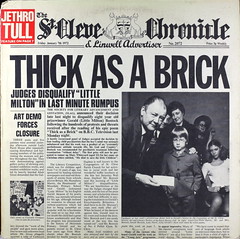 The next album really was over the top -- a parody of the progressive rock album from groups like Yes or Emerson, Lake and Palmer, one long, continuous, seamless 44-minute song that stretched over both sides of an LP. In addition to their standard guitar, drums, piano, Hammond organ and flute (yes, flute), they added the harpsichord, xylophone, lute, trumpet and string section. The concept was that the lyrics were a poem written by a fictitious eight-year-old English schoolboy named Gerald Bostock.
The album cover was another parody, a spoof of an English community newspaper. The main story was about young Gerald being disqualified from a literary competition "following the hundreds of protests and threats received after the reading of his epic poem 'Thick as a Brick' on B.B.C. Television last Monday night."
The entire epic poem, "Thick as a Brick," actually written entirely by Ian Anderson, is after the jump if you're interested. You can hear the song by Googling "Thick as a Brick."
Weekend Assignment #316: National Poetry Month
As April wraps up, let's not let it get away without celebrating National Poetry Month. For this assignment, please share with us something about poetry. Tell us about your favorite poet, or quote us a few lines of your favorite poem, or if poetry doesn't happen to be something you enjoy, tell us why!
April (and the weekend) wrapped up before I could get to the assignment, but I'll give it a shot anyway.
When I first saw the assignment, I was all set to start a diatribe about how much I really don't like poetry. I studied it enough in my younger days that I understand the concept, but as Heinlein would say, I don't grok it. I don't get it on some basic level of understanding. If you want to tell me about something important, give me a few solidly written paragraphs of prose and I'll understand it better.
But after thinking about it some more, I realized that I do like poetry. Just make it rhyme (even if just a little), put it to music and sing it, and I'll get it.
When I was a young tyke, my mother went back to school. One of her textbooks treated some of the pop and rock lyrics of the day -- Simon and Garfunkel, the Byrds, Bob Dylan songs -- as poetry. As I leafed through the book and picked out songs I knew, it gave me a deeper appreciation of them -- that they were important enough to be considered "poetry." Even now, I sometimes have the crazy notion that some of our greatest poets are not exactly poets after all -- they're songwriters.
Continuing on that idea, I'll tell you about a favorite poem, the Baby Boomer generation's "Beowulf "(or maybe it's their "Rime of the Ancient Mariner"). In the late '70s, the rock band Jethro Tull released the album Aqualung. Ian Anderson, the leader of the band, was dismayed that rock critics were calling it a concept album, and said, "If the critics want a concept album we'll give the mother of all concept albums and we'll make it so bombastic and so over the top."
The next album really was over the top -- a parody of the progressive rock album from groups like Yes or Emerson, Lake and Palmer, one long, continuous, seamless 44-minute song that stretched over both sides of an LP. In addition to their standard guitar, drums, piano, Hammond organ and flute (yes, flute), they added the harpsichord, xylophone, lute, trumpet and string section. The concept was that the lyrics were a poem written by a fictitious eight-year-old English schoolboy named Gerald Bostock.The album cover was another parody, a spoof of an English community newspaper. The main story was about young Gerald being disqualified from a literary competition "following the hundreds of protests and threats received after the reading of his epic poem 'Thick as a Brick' on B.B.C. Television last Monday night."
The entire epic poem, "Thick as a Brick," actually written entirely by Ian Anderson, is after the jump if you're interested. You can hear the song by Googling "Thick as a Brick."
Saturday, May 1, 2010


Drill, Baby, Drill
Drill, baby, drill! Worst case scenario: we won't have shrimp...or oysters...or Gulf Coast marshlands...or...
Thursday, April 29, 2010
On My Reading List
I sorta, kinda want to read Pride and Prejudice and Zombies, but I'm concerned that I might not understand some of it since I've never read anything by Jane Austen before. I really, really, really want to read Abraham Lincoln, Vampire Killer.


It even has its own trailer...
![Reblog this post [with Zemanta]](http://img.zemanta.com/reblog_e.png?x-id=63c6c73f-a173-4c52-b1d4-8320e2049e60)

It even has its own trailer...
Monday, April 19, 2010
Weekend Assignment: Summer Reading
The Weekend Assignment has a new home, a blog of its very own. This week's assignment has to do with our summer reading plans...
I've written before about my strange reading habits. I used to be a voracious reader until the Internet came along and gobbled up all of my free time. Now, it takes me much longer to get through a book, but I'll read from almost genre except romance.
My only hard and fast rule is that my next book is always completely different from what I'm reading now. To illustrate: I've been slowly (very slowly) working my way through the bibliography of Charles Dickens, and at this moment I'm about 120 pages into Great Expectations. Before that, there was (working backwards) a quick read about the history of NASCAR; The Black Ice by Michael Connelly, a police procedural thriller/mystery; Mila 18 by Leon Uris, a great piece of historical fiction; The Colorado Kid by Stephen King, an atypical King work -- more unsolved mystery than horror; and The Barrens and Others by F. Paul Wilson, a book of mostly horror short stories.
I've never really noticed any perceptible changes in my reading habits from one season to the next. Summer, winter, spring or fall, my reading doesn't fit any sort of pattern or genre. In the coming months, possibly during the summer, I'll try to find another Dickens book, another King book (I'm waiting for the local library to cough up a copy of Under the Dome), and anything else that strikes my fancy. The point is that I don't know what I'm going to be reading this summer, but the weather outside probably won't play much of a factor.
Okay, yes, I know, it's still spring, but this is when I begin thinking about what kind of summer reading I might like to have on hand for those too-hot-to-clean days of summer. So, for this week's assignment, I want you to share with us the kind of summer reading you look forward to the most. Sci-fi? Horror? Political Thrillers? Romance? It's all good. Now, tell me more!
I've written before about my strange reading habits. I used to be a voracious reader until the Internet came along and gobbled up all of my free time. Now, it takes me much longer to get through a book, but I'll read from almost genre except romance.
My only hard and fast rule is that my next book is always completely different from what I'm reading now. To illustrate: I've been slowly (very slowly) working my way through the bibliography of Charles Dickens, and at this moment I'm about 120 pages into Great Expectations. Before that, there was (working backwards) a quick read about the history of NASCAR; The Black Ice by Michael Connelly, a police procedural thriller/mystery; Mila 18 by Leon Uris, a great piece of historical fiction; The Colorado Kid by Stephen King, an atypical King work -- more unsolved mystery than horror; and The Barrens and Others by F. Paul Wilson, a book of mostly horror short stories.
I've never really noticed any perceptible changes in my reading habits from one season to the next. Summer, winter, spring or fall, my reading doesn't fit any sort of pattern or genre. In the coming months, possibly during the summer, I'll try to find another Dickens book, another King book (I'm waiting for the local library to cough up a copy of Under the Dome), and anything else that strikes my fancy. The point is that I don't know what I'm going to be reading this summer, but the weather outside probably won't play much of a factor.
Friday, April 16, 2010
Quotable
Russian President Dmitry Medvedev on President Obama...
"It's very interesting to be with him. The most important thing that distinguishes him from many other people -- I won't name anyone by name -- he's a thinker. He thinks when he speaks."Hmm. Wonder who he might be thinking of?
Thursday, March 18, 2010

Saturday, March 13, 2010
Redesigning
There's a new look around here. I used the new Blogger Template Designer to change the digs around. How do you like it?
Subscribe to:
Posts (Atom)